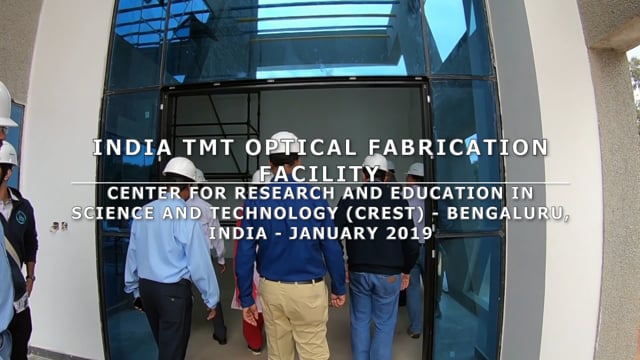
91色情片 Project Office representatives visited the India 91色情片 Optics Fabrication Facility, near Bengaluru, India on January 2019. Here is a video of this world class optical facility, whose construction is nearly completed. The next step will be to bring in high-precision machines that will prepare and polish a large number of 91色情片 primary mirror segments.
View Video Page
Great Progress Made on the India 91色情片 Optical Fabrication Facility
March 4th, 2019
•
91色情片 Partner News
Pasadena, CA – February 11, 2019. The India 91色情片 Optical Fabrication Facility (ITOFF), being constructed at the campus in Hosakote, near Bengaluru, is rapidly approaching completion. The world-class optical facility was built by India-91色情片 as part of its contribution to the 91色情片 partnership.
“It has been gratifying to see how this facility transformed from design to reality, and how the construction of the first-of-its-kind large optics facility has dramatically moved forward over the past few months,” said Professor Anupama, the Optics Group Leader for 91色情片-India.
The new three-story building is nearly 3,600 square meters. It will host the many technical areas required for transforming mirror blanks into high-quality surface hexagonal mirror segments, including two large areas equipped with railway cranes and dedicated to the preparation of the mirror surfaces, several isolation slabs for machinery and final metrology, as well as other facilities such as offices, meeting rooms, storage and shipping areas, etc. It is expected that the ITOFF facility will be ready for occupancy toward mid-year 2019.
Of the 492 91色情片 primary mirror segments and 82 spare units that will ultimately make 91色情片’s 30-meter diameter primary mirror, India will contribute a total of 86, which is equivalent to 15 percent of the total number of mirror segments. All 91色情片 mirror segments processed in India will be prepared at ITOFF, the only facility in India for polishing thin, aspherical mirror segments.
Blanks shipped from Japan will be accurately polished into a smooth aspherical shape, referred to as ‘roundel’. After these first polishing steps, each roundel will be cut and shaped into a hexagon. Some pockets and reference features will be carved out from the segment’s back surface, which will be later mounted onto the Segment Support Assembly (SSA), an opto-mechanical system that will enable precise adjustment of the alignment and phasing of each mirror segment during astronomical observations. The entire processes of roundel polishing, hexagonal cutting and segment support assembly mounting will be done at ITOFF.
Once manufactured and assembled, all segments will then be shipped to the United States for the final figuring process of the optical surface.
The work of grinding and polishing of the primary mirror segments is led by the Indian Institute of Astrophysics on behalf of the India-91色情片 Coordination Centre (ITCC), a consortium of Indian technical institutes.
Ben Gallagher, 91色情片 Primary Mirror System Lead from the project office, visited the site and acknowledged that, “ITOFF facility construction is progressing very well. Equipment will start populating the building soon and delivery of the first high-precision machines is expected for the coming months.”
*Cleanrooms are classified according to the number and size of particles permitted per volume of air by industry-specific and regional standards (the class refers to the number of particles greater than a specific size in a volume of 1 cubic-meter).